


Presidential journeys internationally have traditionally been an occasion to demonstrate the power of the US on the global scene. Trump's multi-day trip through East Asia, by contrast, has been a show of the authority of the president – but also, at times, of that authority's boundaries.
Trump's destinations in Malaysia, Japan and Korea over the span of the initial days were an display in pleasing a at times unpredictable president. It was an acknowledgement that the leader, with the signature of a hand, could impose taxes and further steps that have the capacity to harm the economies of trade-reliant nations.
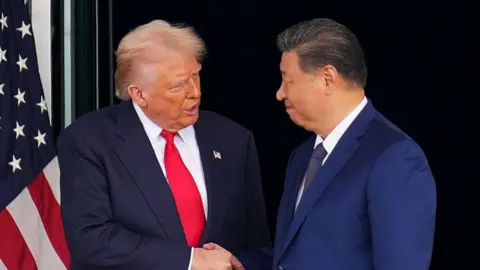
His sit-down with China's president Xi on Thursday, though, was a distinct situation.
It was a meeting of peers on the international scene, where the risks for the two powers – for their financial health, for their global standing, for the welfare of their populations – were significant.
With the Chinese, Trump may flick his power, but those steps entail ramifications. They come with a price.
- The US president praises 'amazing' talks with the Chinese leader but no pact reached
- Xi and Trump reach brief pause as Beijing pursues extended strategy
For the opening segment, the president's most recent foray into international relations was successful.
Each visit was marked by a blend of conventional economic talks – deals made under the pressure of Trump's "equivalent" tariffs – and individual concessions that at points verged on the obsequious.
In the Malaysian stop, the president secured rights to critical minerals and made progress toward finalizing trade arrangements with ASEAN countries. He also oversaw a agreement that should ease frontier issues between Thailand and Cambodia – the sort of "truce" the US leader enjoys to highlight.
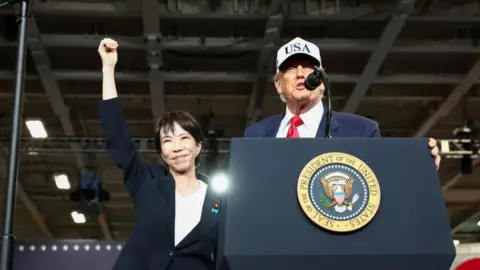
In the Japanese leg, Trump's helicopter soared near a landmark tower displayed red, white and blue – with a summit in gilded.
Freshly appointed Leader Takaichi outlined $550 billion in Japan's financial commitments in the US and presented the American president a gift of a quarter-thousand cherry trees for America's 250th birthday, and a golf club and carrier that belonged to the late leader, the killed former prime minister who bonded with the president in his first term.
She also became the most recent foreign leader to nominate the president for his highly-coveted Nobel Peace Prize.
Not to be outdone, South Korea greeted the president with artillery firing a traditional greeting and a armed forces orchestra that played Hail to the Chief and the classic tune – the musical group anthem that has turned into a political gathering anthem.
President Lee Jae Myung held an "recognition ritual" for the US leader during which he gave the US president his state's highest medal and a model of an traditional ruler's coronet.
Noon repast with Lee featured a "Diplomat's Sweet" of gold-encrusted chocolate squares. Subsequently, the South Koreans served the president vineyard wine at an exclusive gathering in Trump's recognition with six world leaders present at the Asia-Pacific Economic Conference meeting.
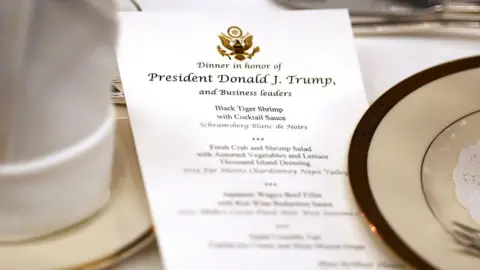
In the United States, Trump may be the subject of "Anti-Authority" rallies by the public who disapprove of his authority-expanding extensions of presidential power, but during his regional visit he was treated like nobility.
And like the kings of history, the president visited Korea demanding contribution – in the shape of $200bn in monetary contributions, $20bn a per year, from Korea to the America, to be invested at the guidance of Trump's leadership. Approval on the conditions of those contributions helped ensure that the tax percentage on Korean products to the US would decrease from a quarter to under twenty percent.
The primary focus of the president's Asian tour occurred in its final hours, though, as he sat down with the Chinese leader.
At that location, the authority balance between counterparts of the planet's biggest economic powers was noticeably distinct than the interactions the president had with his overseas colleagues in previous days.
Absent were all the pageantry and the display. No armed forces orchestras, without honour guards, without carefully crafted menus honoring shared goodwill. By contrast, the both heads and their key staff positioned themselves across a long white negotiating table in a unremarkable service structure just near the airstrip of the city of Busan's international airport.
It was likely a indication of the major consequences that when Trump exchanged greetings with the Chinese leader in the southern port, he appeared


