
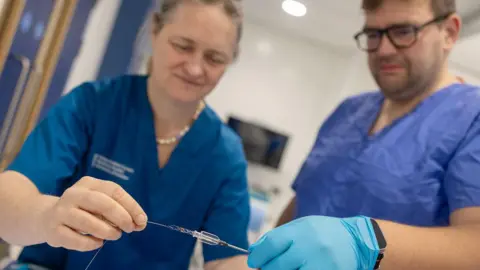
Medical professionals from Scotland and the United States have accomplished what is thought of as a historic stroke procedure employing automated systems.
The lead surgeon, from a Scottish university, performed the remote thrombectomy - the removal of blood clots following a stroke - on a donated body that had been donated to medical science.
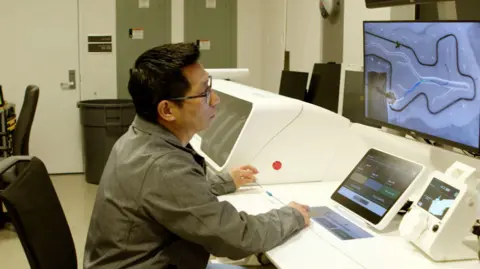
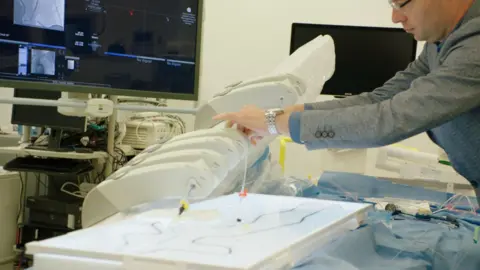
The surgeon was working from a major hospital in the Scottish city, while the subject undergoing procedure via the machine was at another location at the research facility.
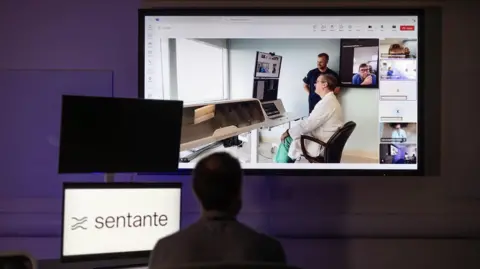
Hours later, a medical specialist from Florida utilized the equipment to perform the initial intercontinental procedure from his American facility on a medical specimen in Scotland over 6,400km away.
The team has labeled it a potential "revolutionary development" if it receives authorization for medical treatment.
The medics believe this system could revolutionize cerebral healthcare, as a slow access to expert care can have a direct impact on the recovery prospects.
"The experience was we were observing the initial vision of the future," stated Prof Grunwald.
"While in the past this was thought to be science fiction, we demonstrated that each phase of the operation can currently be accomplished."
The University of Dundee is the worldwide teaching facility of the global medical association, and is the exclusive site in the Britain where surgeons can treat cadavers with biological fluid flowing through the blood pathways to mimic treatment on a actual patient.
"This marked the initial occasion that we could perform the whole mechanical thrombectomy procedure in a actual human specimen to show that each stage of the surgery are feasible," stated the primary researcher.
A charity executive, the director of a stroke charity, described the long-distance operation as "an extraordinary advancement".
"For too long, residents of isolated regions have been deprived of access to clot removal," she stated.
"Robotics like this could correct the imbalance which occurs in stroke treatment across the UK."
How does the technology work?
An ischaemic stroke takes place when an vascular pathway is clogged by a blockage.
This disrupts blood and oxygen supply to the brain, and neurons lose function and die.
The optimal therapy is a thrombectomy, where a specialist uses medical instruments to extract the blockage.
But what happens when a person can't get to a specialist who can conduct the operation?
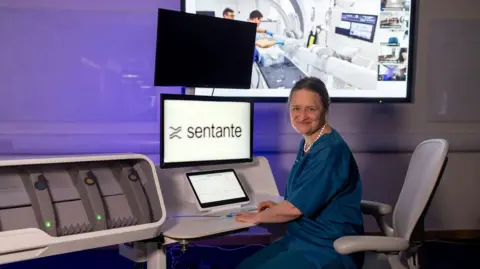
Prof Grunwald explained the experiment proved a mechanical device could be attached to the equivalent surgical tools a surgeon would conventionally utilize, and a healthcare professional who is present with the individual could easily connect the tools.
The specialist, in another location, could then operate and direct their individual tools, and the automated system then executes precisely identical actions in live timing on the patient to carry out the thrombectomy.
The patient would be in a treatment center, while the surgeon could conduct the procedure with the automated equipment from any location - even their personal residence.
Prof Grunwald and the neurosurgeon could observe real-time imaging of the specimen in the trials, and track developments in live conditions, with the lead researcher stating it took merely twenty minutes of training.
Technology companies Nvidia and Ericsson were participated in the project to ensure the communication link of the robot.
"To operate from the United States to Britain with a 120 millisecond lag - an instant - is genuinely extraordinary," stated Dr Hanel.
Innovations in cerebral healthcare
Prof Grunwald, who has been honored for her work and is also the vice president of the World Federation for Interventional Stroke Treatment, said there were primary challenges with a traditional procedure - a international lack of doctors who can perform it, and intervention relies upon your geographical position.
In Scotland, there are merely three sites people can access the surgery - urban centers. If you reside elsewhere, you must journey.
"The treatment is extremely time-critical," said the medical expert.
"For every six minutes of waiting, you have a slightly decreased likelihood of having a successful recovery.
"This technology would now offer a novel approach where you're not depending on where you dwell - conserving the valuable minutes where your cerebral matter is deteriorating."
Medical statistics indicated there were {9,625 ischaemic strokes|numerous cerebral events|


